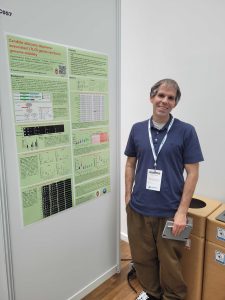
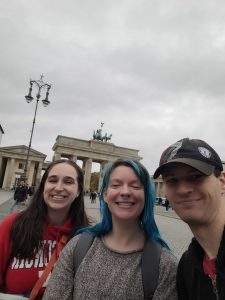
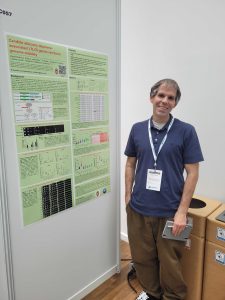
This past October 4 members of our lab attended the prestigious Candida and Candidiasis 2025 international conference in Berlin, Germany!
Our PI Matt Anderson presented a talk on behalf of Zinnat Shahina, on “Candida albicans TLO genes control genome instability and gene expression”. The talk and poster focused on research demonstrating that function of paralogs in the telomere-associated (TLO) gene family is mostly dictated by clade architecture but with some interesting exceptions.
Shane Hendricks presented a poster titled “Determining the individual function and effect of structural variation among the TLO gene family members of Candida albicans” in which he shows differential effects of TLO genes on morphology, growth rate, and stress sensitivity when a full knockout is rescued with individual genes.
Emily Simonton presented a talk titled “Members of the TLO (telomere-associated) expanded gene family display interwoven transcriptional and phenotypic roles in Candida albicans“. They highlighted the importance of gene duplications and gene family expansions for Candida’s adaptability across host niches, while alluding to data that supports the hypothesis that TLO paralogs are largely redundant in favorable conditions, but that the paralogs become more specialized upon greater perturbation.
Siobhan Dietz presented a talk and poster titled “Transcriptional Decoupling of Filamentation and Damage in Candida albicans“. She focused on the transcriptional profiling of a commensal and pathogenic strain of C. albicans across a time course and revealed that they shared very similar transcriptional filamentation profiles despite displaying very different filamentation and damage phenotypes.
Thank you all, for representing the Anderson Lab at such an influential and important international conference!